LEGAL DEVELOPMENTS | Jan. 3, 2026
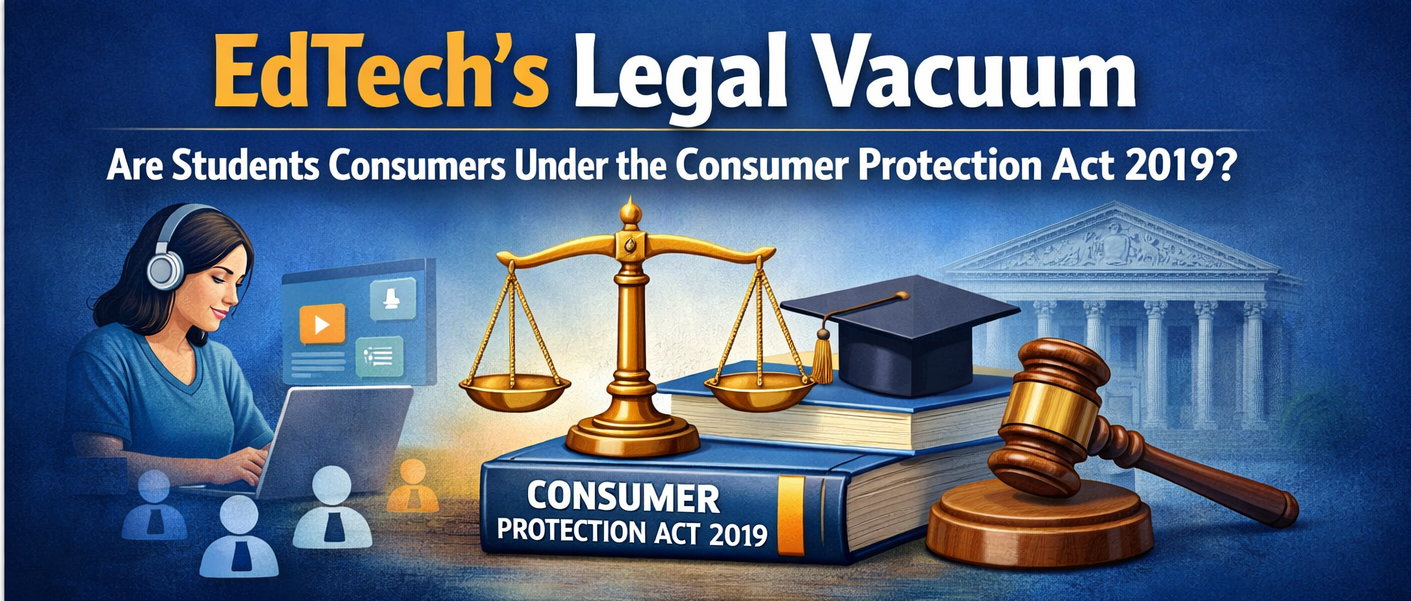
The legal vacuum surrounding EdTech platforms: Are students ‘consumers’ under the Consumer Protection Act 2019?
This Article has been written by Resu Kunari, LL.B, 1st Year,ICFAI University & Sakshi Kothari, Assistant Professor at ICFAI University
The EdTech paradox: When does a student become a consumer?
In the traditional understanding of the Indian legal system, education has long been considered a “noble mission” a charitable endeavor distinct from the raw commercialism of business. For decades, the Supreme Court has kept educational institutions outside the purview of consumer laws, stating that students are not “consumers” and education is not a “commodity.”
But in 2025, the classroom has transformed. It’s no longer just a brick-and-mortar hall; it’s an app, a pre-loaded tablet, and a subscription model driven by aggressive venture capital. This rapid digitalization has created a massive educational technology (EdTech) sector that is currently operating in a significant “legal vacuum.”
The central question facing lawyers, regulators, and millions of Indian families is this: If an EdTech platform operates like a tech giant using data analytics, targeted advertising, and standard-form contracts should it still be afforded the legal exemptions of a charitable trust?
"Noble Mission" vs. Commercial Reality
To understand the current conflict, we must look at the "old rules" of legal precedents. Most educational institutions base their defense on the Supreme Court's judgment in the case of P.T. Koshy and Others vs. Ellen Charitable Trust (2012). The court ruled that educational institutions are not providing a "service" under the Consumer Protection Act (CPA), and therefore, consumer forums have no jurisdiction over them.
EdTech platforms often cite this to claim exemption. However, this argument ignores reality. Unlike statutory universities regulated by the UGC or AICTE, most EdTech companies are private limited companies that operate as technology aggregators. They do not confer degrees; they sell "products" and "coaching."
The "legal vacuum" is essentially a clash between 20th-century laws that view education as a charitable endeavor and 21st-century businesses that operate it as a highly profitable enterprise.
Manu Solanki Watershed: The Truth Behind the Scenes
The legal landscape began to shift with the review by the National Consumer Disputes Redressal Commission (NCDRC) in the Manu Solanki v. Vinayaka Mission University (2020) case.
Considering the commercialization of coaching, the Commission drew a crucial distinction:
- Educational Institutions: Schools and colleges that perform statutory duties (admissions, examinations) will remain outside the purview of the Consumer Protection Act (CPA).
- Coaching Centres: Institutions that provide training for a fee—without conferring any statutory degree will fall under the ambit of the CPA.
Why? Because coaching centres provide a “service” in exchange for a “fee” and do not perform any governmental function. While the Supreme Court’s final decision on the appeal is still pending, lower courts are currently using this distinction to hold EdTechs accountable.
The "Trojan Horse" of Hardware
One of the most interesting legal developments is how hardware is bringing EdTech companies under the purview of the Consumer Protection Act (CPA). Large players often sell hybrid packages: a subscription (service) bundled with a tablet or SD card (goods).
Even if a platform argues that its teaching is not a service, the sale of a tablet is undoubtedly the sale of "goods." Under the CPA 2019, product liability (Sections 82-87) applies if the device is defective.
In the recent Biswajit Dash v. Byju's (2024) case, a District Commission rejected the "education is not a service" defense because the dispute involved a defective tablet. The Commission stated that edtech transforms education into a product, making the platform liable for refunds.
Marketing Deception: "Guaranteed Success"
Perhaps the most visible battleground is advertising. The EdTech and coaching sectors are notorious for creating "FOMO" (fear of missing out), buying topper ranks, and making exaggerated claims like "guaranteed selection."
In response, the Central Consumer Protection Authority (CCPA) issued strict guidelines in 2024. These guidelines explicitly prohibit:
- False urgency: Institutions can no longer use timers like "Offer ends in 10 minutes!" to pressure students.
- Misleading attribution: Institutions must now disclose whether a "topper" completed the full classroom course or only a free mock interview.
- Consent: They must obtain written consent to use a student's photo after selection, ending the practice of forcing students to waive publicity rights at the time of admission.
The impact of these regulations was felt in 2024 when the CCPA fined Vision IAS ?11 lakh for misleading advertisements. The institution had claimed 79 selections in the top 100 but concealed the fact that many students had only purchased low-cost test series, not their main course.
Conclusion: From Caveat Emptor to Caveat Vendor
The "legal vacuum" is closing. While we await the Supreme Court's definitive ruling in the Manu Solanki case, the reality at the District Commission level is clear: EdTech students are consumers.
For legal practitioners and law students, the EdTech sector presents a fascinating intersection of administrative law, consumer protection, and technology regulation. The days of hiding behind the "noble mission" of education are over. As the Kunal Yadav and Vision IAS cases demonstrate, if you run education as a business, the law will treat you as such.
The situation has shifted from caveat emptor (buyer beware) to caveat vendor (seller beware).
Reference
Primary Legal and Statutory Sources
- Consumer Protection Act, 2019:
- Consumer Protection Bill, 2019 (PRS India):
- Consumer Protection (E-commerce) Rules, 2020:
- Guidelines for Prevention of Misleading Advertisements in the Coaching Sector, 2024 (CCPA):
- Section 79 – IT Act, 2000 (Safe Harbour for Intermediaries):
Case Law and Judgments
- Kunal Yadav vs. Byju’s: District Consumer Disputes Redressal Commission (2025)
- Manu Solanki & 8 Others vs. Vinayaka Mission University: National Consumer Disputes Redressal Commission
- Amrit Kaundil vs. Byju’s: District Consumer Disputes Redressal Commission
- TERI University vs. Ms. Nikita Jain: Educational Institutions outside CPA jurisdiction
News and Articles
- Governance Imperatives for EdTech Companies in India – Law.asia
- Byju’s asked to refund ?1.12 lakh for ‘deficiency in service’ – Bhubaneswar News/Times of India
- CCPA slaps ?11 lakh fine on Vision IAS for misleading advertisements – The Hindu
- Ensuring Transparency: The 2024 Guidelines on Preventing Misleading Advertisements – Chambers and Partners
- Safe Harbour under Section 79 IT Act: Why Legal Immunity for Platforms is Fading – K.S. & Co.
- Bill to set up single higher education regulator gets Cabinet nod – The Hindu
- The Case for Holding EdTech Companies Accountable Under FERPA – TechPolicy.Press
Academic and Research Papers
- Protecting Consumers of Education: A Critical Analysis
- Unveiling the Dark Side of Educational Technology: Consumer Protection for the Digital Age – ResearchGate
- Harmonizing ‘Fall-Back Liability’ and ‘Safe Harbour’ in India’s E-commerce Jurisprudence


Comments (0)